




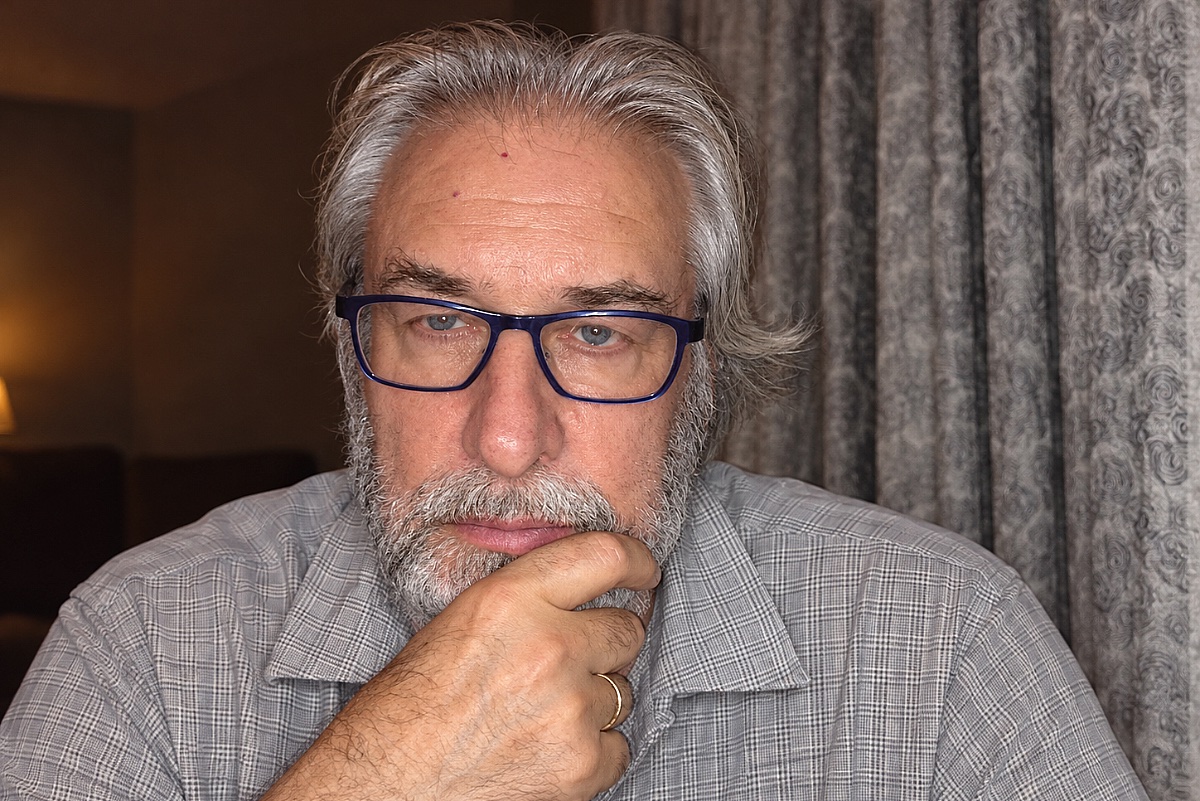
More than five decades after returning from Vietnam, Larry Winters still feels the tug of war and the moral injuries left by his service there.
“The Tug of War: A Reckoning with Moral Injury and Telling the Truth” is the title of his new book. It is shaped by his life as a Marine combat veteran, his years as a psychotherapist, and his ongoing efforts to understand war, family, responsibility, and healing.
Coming to terms with the effects of war has taken a lifetime. Winters, now 78, credits his wife, his writing, and his creative pursuits — including woodworking and sculpting — with helping him heal. He also credits Empire State University with helping him launch a career in counseling and dedicate himself to others, especially veterans struggling with their own experiences.
“Empire gave me a doorway into education at a time when my life did not follow the traditional road,” he says. “That education eventually helped me become a licensed mental health counselor and work for 25 years as a psychotherapist. In many ways, Empire State helped me turn lived experience into service.”
Injuries Inflicted
Winters grew up in New Paltz, NY, in a house without running water or plumbing. He spent much of his childhood helping repair it while living with a difficult father.
At 16, Winters and a friend built a cabin in the nearby woods, where they lived until he enlisted in the Marines in 1967. He hoped the Marines would help him become a man and stand up to his father.
Boot camp was brutal. Being sent to Vietnam while many of his friends at home were protesting the war was difficult in another way. About six months into his time in Vietnam, Winters says he was ordered to fire at civilians fishing off Marble Mountain Air Base.
“This incident pushed me beyond inhumanity,” he says. “It was daylight; they had no weapons, and there were children in the sampans. I refused and fired into the sand. That’s when I woke up to moral injury.”
When Winters returned from Vietnam, he went back to New Paltz. His relationship with his father slowly improved. “Things had shifted,” he says. “He knew I wasn’t going to listen to anything he told me to do. And he saw what the war had done to me but never asked me about it.”
Gift of Life
“I realized I needed to do something with the life I was gifted,”
Winters had not expected to survive the war. Coming home felt like a gift. “I realized I needed to do something with the life I was gifted,” he says.
Like many returning Marines, Winters wanted to rejoin ordinary life. He married, had a child, and bought a taxi company. “Slowly, I realized I needed to get educated,” he says. “I needed to get focused on what was still going on in my internal world.”
He went to a community college, where he was shocked by what he saw. “They were literally throwing spitballs in class,” he says. “The other vet and I were looking at this and asking each other, ‘What on earth is going on?’ What are they doing? They could be headed to Vietnam.’”
A professor urged Winters to write poetry about the war. Writing became a form of self-therapy, helped him understand his own experience, and begin to see how he might help others.
Winters eventually found Empire State University. There, faculty member Steven Lewis encouraged him to join a writing group. The group met in Winters’ home for 15 years, and led to the publication of Winters’ memoir, “The Making and Unmaking of a Marine.”
Healing Through Others
It took Winters years to recognize that conventional ideas of success didn't fit what he needed. “I was tired of being told what success is,” he says. “Success is something that takes place inside. It doesn’t take place in what your job is or where you go, or how much money you make.”
A critical part of his healing came in 1994, when he returned to Vietnam. There, he read a poem apologizing to the Vietnamese people and asked for their forgiveness. “The reaction was rather unbelievable,” he says. “They came and hugged me and asked me for my poem.”
With a degree in counseling from SUNY Empire, Winters became a licensed mental health counselor at Four Winds Hospital in Katonah, NY. He also learned psychodrama, a form of group therapy that helped him as well as the people he worked with.
Winters specialized in working with veterans and led group therapy sessions, treating thousands of people over his career. “Helping other people was as good for me as it was for them,” he says.
Through that work, he came to understand the importance of being present with people who are hurting.
“The best treatment for moral injury is presence, somebody being present to have you tell your story and listen, take it in, and acknowledge it in a significant way,” he says. “That’s presence, being there and listening, so that someone feels heard.”